Binary options compared to spot trading and other ways to start where beginners get a faster, simpler entry
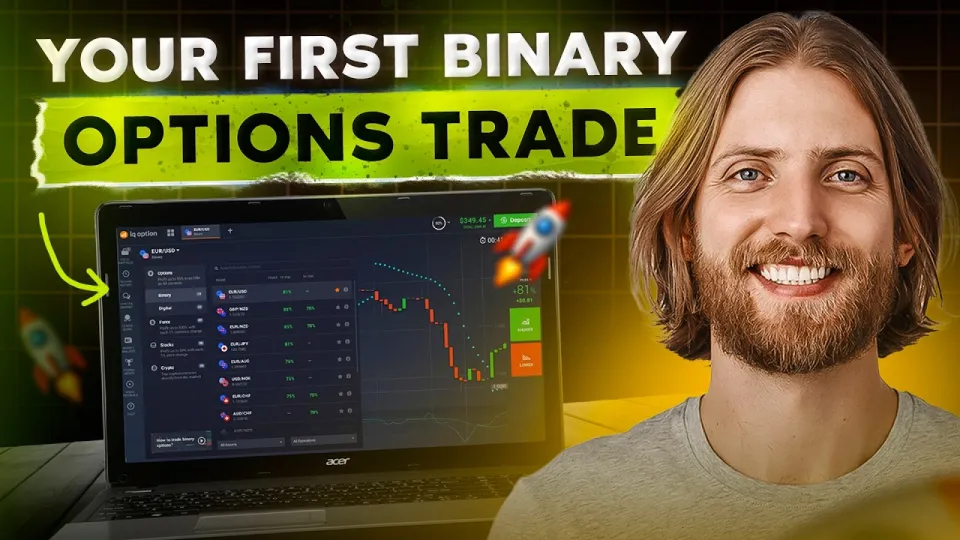
Video: Binary Options | Binary Options Tutorial for Beginners | Where Should You Start?
· based on the channel Binary options tutorial for beginners
Key takeaways
- A binary option pays a fixed amount if the price finishes above or below your strike at expiry; otherwise the stake is lost.
- Quotex, Pocket Option and Binarium are the three platforms named in the tutorial breakdown.
- Most platforms offer contract expiries from 5 seconds to several hours, plus a payout percentage shown before entry.
- Risking 1–2% of the account per trade keeps a normal losing streak survivable.
- A VPN such as Nord VPN is commonly used where a broker's site is restricted.
Binary options are fixed-risk, fixed-time trades: you choose a direction, a strike level and an expiry, and the payout is known before you click. That simplicity is exactly why beginners should start with a demo account on a regulated-style platform such as Quotex, learn how the payout percentage and expiry interact, and only then risk real money in small, fixed stakes.
What a binary option actually is and how the payout works
A binary option has exactly two outcomes at expiry. If your forecast is right, the platform credits the payout percentage shown at entry; if it is wrong, you lose the stake. There is no partial exit and no stop-loss once the contract is open, which is why position size matters more than the forecast itself.
Typical mechanics to check before your first trade:
- Payout percentage — a 70–90% payout means a win of 0.70–0.90 of the stake, while a loss is the full stake, so you need a win rate above roughly 53–59% to break even.
- Expiry length — from 5 seconds on some platforms up to a day; shorter expiries behave closer to a coin flip.
- Strike price — usually the current price at the moment of entry, which removes slippage but also removes any edge from waiting.
- Minimum stake — commonly $1–$10, which is what makes small-account testing realistic.
Binary options compared with spot trading and CFDs
Binary options differ from spot trading in that you never own the asset and never face a margin call. With a spot purchase or a CFD you can hold a position, average in, set a stop and manage the trade while it is open; with a binary contract the risk is frozen at entry and only time remains as a variable.
That comparison cuts both ways. The fixed loss is a genuine advantage for a beginner who struggles with discipline, because no single trade can wipe out an account. The disadvantage is pricing: the payout is set by the platform, so the house edge is baked into every contract, and no amount of chart study removes it. Spot trading and CFDs carry spread and swap costs instead, but the outcome depends on how far the price moves, not just on which side of the strike it lands.
How to start on Quotex, Pocket Option or Binarium
A first session should be a checklist, not a hunt for a signal. The three platforms highlighted in the tutorial breakdown — Quotex, Pocket Option and Binarium — all follow the same basic flow, so the routine transfers between them.
- Register and open a demo account; most platforms fund a practice balance automatically.
- Set the chart to a familiar asset with tight spreads and active hours, such as EUR/USD or BTC/USD during a major session.
- Pick one expiry length and keep it constant for at least 20 trades so the results mean something.
- Record every trade: direction, expiry, stake, result and the reason for entry.
- Move to real money only after the demo log shows a stable process, not a lucky streak.
Risk rules that keep a beginner account alive
Risk management is the only part of binary options a trader fully controls, so it deserves a written rule set. A practical starting point for a small account:
- Cap each trade at 1–2% of the balance; at $500 that is $5–$10 per contract.
- Limit the session to 5–10 trades or a fixed loss of 5% of the account, whichever comes first.
- Avoid martingale doubling after losses; a run of six losses at doubling stakes costs 63 times the first stake.
- Skip news releases on the traded pair unless the strategy is built around volatility.
- Withdraw a portion of profits rather than compounding everything.
Common beginner questions and doubts
Most doubts from new traders come down to three things: whether the platform is fair, whether a strategy exists, and how much money is needed. On fairness, the payout percentage is the visible cost and should be compared across platforms before depositing. On strategy, price action around support and resistance plus one indicator for confirmation is a more realistic starting point than indicator stacking. On capital, a $100–$200 account is enough to learn the mechanics, but not enough to expect meaningful income.
Access is a separate practical issue: some brokers restrict certain regions, which is why a VPN such as Nord VPN appears in the same toolkit as the trading platforms.
Platforms and tools from the tutorial
- Quotex — registration and trading account
- Pocket Option — platform sign-up
- Binarium — broker website
- Nord VPN — VPN access
Conclusion
Binary options suit a beginner who wants a defined risk per trade and a fast feedback loop, but only if the payout percentage, expiry and stake size are treated as the core of the strategy rather than an afterthought. Start on demo with Quotex, keep stakes at 1–2% of the balance, log at least 20 trades before going live, and compare payouts across platforms before committing funds. The video breakdown on the Binary options tutorial for beginners channel walks through the same starting sequence and is a reasonable companion to this plan.
Source: Binary Options | Binary Options Tutorial for Beginners | Where Should You Start? · Markdown version
Questions & answers
How much money do I need to start with binary options?
A $100–$200 account is enough to learn the mechanics and keep stakes at 1–2% per trade. Most platforms accept minimum stakes of $1–$10, so the account size mainly determines how many trades you can take before a losing streak becomes a problem.
Are binary options gambling or trading?
They sit close to the line. The outcome depends on price direction, but the payout is set by the platform, so a house edge is built in. Treating them as trading requires a written rule set, a trade log and strict position sizing rather than chasing signals.
Which expiry time should a beginner choose?
Longer expiries of 15 minutes to a few hours leave room for a chart-based forecast, while 5-second and 1-minute contracts behave almost randomly. Pick one expiry and keep it constant for at least 20 trades so the results can actually be evaluated.
Do I need a VPN to use these platforms?
Only if the broker restricts your region. A VPN such as Nord VPN is often used for access, but check the platform's terms first, since trading through a VPN can conflict with local rules and with the broker's own conditions.